
Why recovery is an active part of your training management
You’ve just completed a tough session. The intervals went well. The wattage figures are spot on. The training stimulus has been applied. On paper, it all looks like a successful training session.
But whether this session actually makes you better is by no means certain at this stage. Because training itself doesn’t immediately make you perform better.
It makes you tired.
During a demanding session, you deplete your energy reserves, generate metabolic and mechanical stress, and disrupt your body’s physiological balance. That is exactly the intention. Because this stress provides the stimulus to which your body can subsequently respond. The crucial part comes afterwards.
During the recovery phase, your body attempts to process the stresses caused by the training and prepare for future demands. Energy stores are replenished, strained tissues are repaired, and training-induced adaptation processes are triggered.
The training stimulus is therefore not the result. It is merely the signal to your body to adapt.
Whether this instruction can be successfully carried out depends on what happens afterwards. This is precisely where one of the most common misunderstandings among ambitious endurance athletes arises. Training feels productive. A rest day does not.
60 minutes of threshold intervals can be measured. 280 watts are recorded in the training log. The training load appears in the app and the completed session is ticked off in the calendar. Recovery leaves far fewer visible traces.
Eight hours’ sleep doesn’t produce a wattage figure. A light day doesn’t increase your training load. And a session you’ve deliberately skipped doesn’t look particularly impressive in any statistics. This gives rise to a dangerously simple equation:
More training = more progress.
Physiologically, however, training doesn’t work like that. Too little load may not provide sufficient stimulus. The right amount of load can trigger adaptation. Too much load combined with insufficient recovery, on the other hand, can lead to fatigue accumulating faster than performance improves. The crucial question is therefore not:
“How much training can I do?”
But rather:
“How much training can I manage in such a way that it leads to long-term adaptation?”
This is a fundamental difference. And that is precisely why recovery is not the opposite of training. It is an integral part of it.
How training actually leads to improved performance
Training does not improve your performance immediately. It provides a training stimulus to which your body can respond with various adaptation processes. Whether and to what extent these adaptations occur depends, amongst other things, on the type and intensity of the training, your current fitness level, your energy supply and the available recovery time. At first glance, this sounds obvious. In practice, however, this relationship is often greatly oversimplified.
A well-known model describes training as classic supercompensation:
Exertion initially reduces performance. During recovery, it rises again and briefly exceeds the original level. This is precisely where the next training stimulus should then be applied. As a basic explanatory model, this concept is helpful. The reality, however, is more complex.
Your body does not have a single ‘recovery switch’ that springs back to ‘ready’ after a certain number of hours. Different systems react differently to exercise. Glycogen stores can be replenished relatively quickly if sufficient carbohydrates are available. Muscle damage and localised fatigue can persist for longer. The autonomic nervous system can react to high training loads, lack of sleep or psychological stress.
At the same time, the actual training adaptations also occur on different timescales.
After endurance training, for example, signalling pathways are activated that can support long-term changes in mitochondrial function, capillarisation and various enzyme systems. After a single session, you are therefore not simply either ‘recovered’ or ‘not recovered’. You are in the midst of a dynamic process.
Fitness and fatigue occur simultaneously
A more helpful model therefore views training as the interplay of two effects:
Fitness and fatigue.
Every effective training session can provide a positive stimulus for adaptation. At the same time, it causes fatigue. In the short term, this fatigue can be much more noticeable than the actual fitness gain. After a tough training block, you may therefore objectively be in better shape but still feel worse or be temporarily less able to perform at your best.
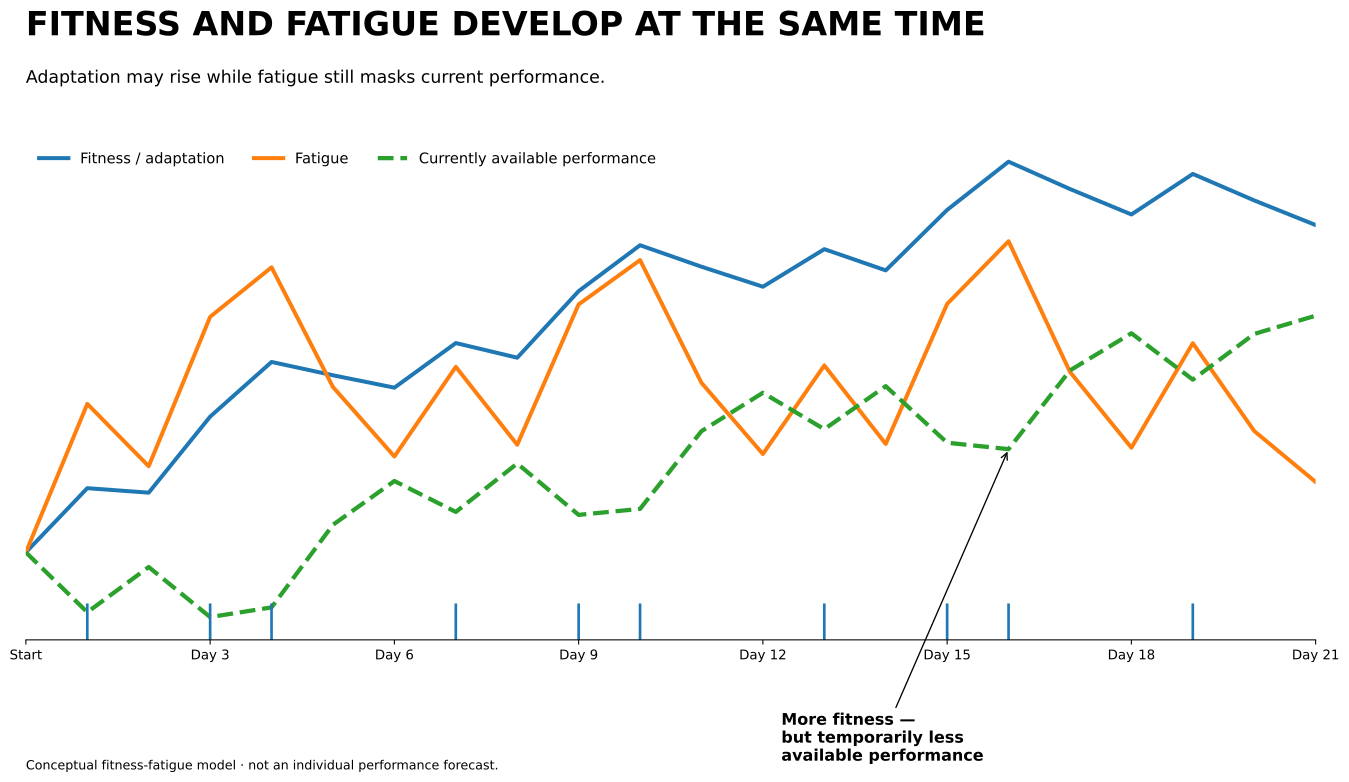
This is not a contradiction.
It is a normal part of training. The art of training management therefore does not lie in completely avoiding fatigue. Without stress, there is no adaptation. Without sufficient stimulus, there is no progress.
The aim is rather to deliberately induce fatigue without consistently accumulating more than your body can cope with.
This is precisely where recovery takes on its true significance. Its purpose is not to ensure that you feel completely refreshed every morning. It creates the conditions that allow stress to be applied productively time and again.
A good training plan is therefore not simply a collection of sessions designed to be as effective as possible. It is a system of exertion and recovery. The quality of this system is not determined by how hard a single day was, but by whether, over weeks and months, you can apply, process and repeat sufficient high-quality training stimuli.
The aim of recovery is not to prevent fatigue. The aim is to make fatigue productive.
Fatigue does not automatically mean that you are training too much
Fatigue following a demanding training session is, first and foremost, a normal and expected reaction to exertion. It does not automatically mean that you need more recovery or that you should skip your next training session. What matters is how pronounced the fatigue is, how long it lasts and whether it impairs your ability to effectively process the next planned training stimuli.
Anyone who trains regularly will not be fully recovered every day. Nor does that have to be the aim. After an intense session, your legs may feel heavy. After several demanding days of training, general tiredness may set in. Performance levels may also drop temporarily within a training block. This is all part of structured training.
It only becomes a problem when planned fatigue turns into a strain that no longer dissipates sufficiently.
Productive fatigue is part of training
A training block is designed to challenge the body. If every session were carried out only when the body was fully recovered, it would be almost impossible for many athletes to achieve a meaningful training volume. That is why training stimuli are deliberately combined.
A moderate endurance session, for example, can still be beneficial despite slight residual fatigue. Even several consecutive days of training can form part of a well-planned training block. What matters is not whether fatigue is present, but how it develops.
An athlete can be tired and still train effectively. Similarly, an athlete can feel subjectively well and yet show signs of increasing accumulated stress. This is precisely why simple rules such as
‘Tired = rest’
or
‘I feel good = go full throttle’
are too simplistic for effective training management.
When fatigue begins to lose its function
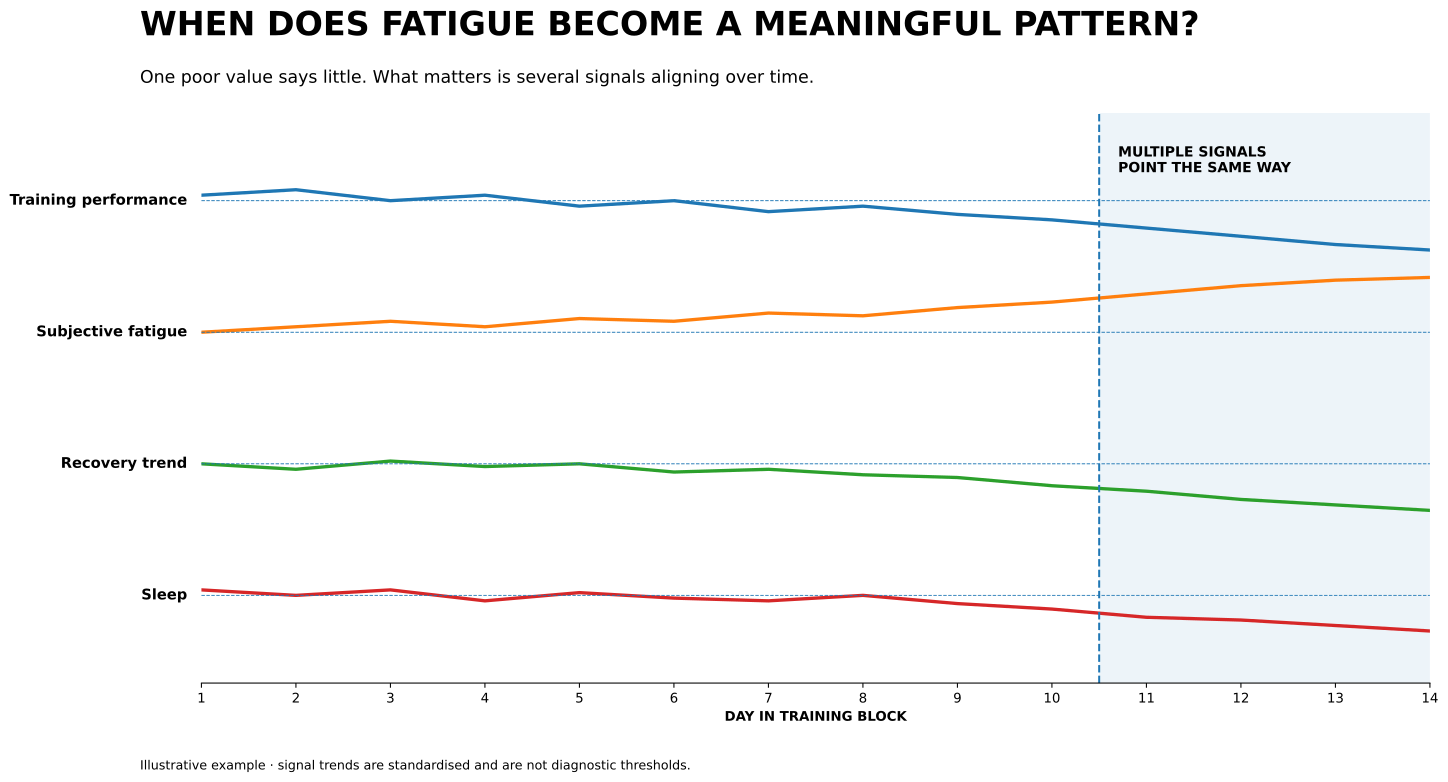
The situation becomes more interesting when several signals point in the same direction at the same time. Your usual wattage feels unusually hard over several sessions. Performance drops despite high effort. Motivation to train decreases significantly. Sleep quality deteriorates. Your legs remain heavy for an unusually long time. Your resting heart rate or HRV changes significantly over several days compared to your personal baseline. Or your subjective sense of recovery steadily worsens.
None of these signals, on their own, proves that you’re training too much. Together, however, they may indicate that stress is building up faster than it’s being processed. This is precisely where the difference lies between a single metric and a pattern.
A poor recovery score does not in itself dictate a training decision
Wearables have made it much easier to monitor recovery. HRV, resting heart rate, sleep duration, skin temperature and other parameters can provide helpful insights into how your body is responding to training and everyday stress.
It becomes problematic when a single measurement is immediately interpreted as a call to action. A low HRV does not automatically mean:
No training today.
Nor does a high recovery score mean:
Maximum intensity today.
These figures need context. What was the training load over the past few days? How do you feel? What session is actually on the schedule today? How important is it within the training week? How did you sleep? Is there any unusual stress at work or in your personal life? And above all:
Is this a one-off deviation or a trend?
Only by combining all this information can you make a sensible training decision. That is precisely why recovery management shouldn’t aim to produce the most perfect readings possible every single day. The goal is different:
Enough recovery to ensure that the next relevant training session can fulfil its purpose.
Sometimes that means a rest day. Sometimes a shorter session. And sometimes it means completing exactly the training session that was planned, despite your legs feeling a bit heavy.
Overreaching is not the same as overtraining
Short-term drops in performance following a high training load do not automatically constitute overtraining. In training science, a distinction is made between temporary fatigue, functional overreaching, non-functional overreaching and the significantly more serious overtraining syndrome.
These terms are often confused in everyday language. After three hard days of training, your legs feel heavy and your performance drops.
“I’m overtrained.”
After an intensive week of training, HRV is lower than usual.
“I desperately need a week’s break.”
In most cases, this does not indicate genuine overtraining. It primarily describes fatigue. And fatigue is a necessary part of training.
Functional overreaching: deliberately increasing the workload
During certain training phases, the workload can be deliberately set high enough to cause a short-term drop in performance. The athlete feels more tired. Their legs don’t respond as well. Certain performance metrics may temporarily decline.
Following sufficient recovery, this can be followed by an improvement in performance. This principle is known as **functional overreaching**. The key word here is ‘functional’. The increased workload serves a purpose. It is planned. It is time-limited. And it is followed by sufficient recovery.
Therefore, a temporary reduction in performance is not necessarily a problem. It can be part of the training process.
When training load no longer results in meaningful adaptation
The situation is different with **non-functional overreaching**. Here, performance remains reduced over a longer period and the necessary recovery time increases significantly, without resulting in a corresponding additional gain in performance. The training load has then lost its productive function.
More training no longer leads to adaptation. Above all, it leads to greater fatigue. It is precisely this transition that is difficult to recognise in practice. This is because there is no single measurement that clearly indicates:
From today onwards, your fatigue is no longer functional.
Rather, the trend becomes apparent over time. Performance data. Subjective perception. Sleep. Motivation. Training quality. Physiological markers.
All this information can provide clues. None of it, on its own, provides the answer.
Genuine overtraining is something else
It is important to distinguish this clearly from Overtraining Syndrome (OTS). This is not simply a few bad days following a tough training block. Overtraining Syndrome is associated with a prolonged decline in performance and other symptoms, and may require a very long recovery period.
Compared to normal training fatigue or short-term overreaching, genuine OTS is significantly rarer. Therefore, it is of little help to immediately interpret every phase of increased fatigue as ‘overtraining’. However, the other extreme is equally unwise:
constantly ignoring warning signs because intense exertion is, after all, part of training. The crucial skill lies somewhere in between.
Allow fatigue as long as it remains productive – and react when it begins to permanently impair the quality of your training.
This sounds less clear-cut than a red or green traffic light. But that is exactly how training management works. It is not about avoiding fatigue. It is about allowing the right amount of it at the right time.
What determines how quickly you recover?
How quickly you recover from training depends on the type and intensity of the workload, your fitness level and the conditions you provide for your body afterwards. The most important factors you can influence include sleep, adequate energy and nutrient intake, and sensibly managed overall workload.
Recovery has now become a market in its own right. Compression boots. Massage guns. Ice baths. Saunas. Supplements. Breathing exercises. Wearables.
Some of these measures may be useful in certain situations. However, they rank much lower in the hierarchy than their marketing often suggests. Anyone who regularly gets too little sleep, consistently fails to consume enough energy and poorly manages their training load will not be able to compensate for this deficit with a massage gun. The foundation of successful recovery is far less spectacular.
Sleep: probably your most powerful recovery tool
Sleep influences numerous processes relevant to recovery and performance. Too little sleep or poor-quality sleep can affect, amongst other things, cognitive performance, reaction times, mood and perceived exertion. Repeated sleep deprivation can also compromise training quality and recovery. For athletes, therefore, it is not just the previous night that matters. Sleep deficits can also accumulate over several days.
However, this does not mean that a single bad night’s sleep automatically requires a rest day. Once again, context is key. A relaxed base-level ride after six hours’ sleep is quite different from a demanding VO₂max session following several nights of significant sleep deficit.
Sleep is therefore not a binary training switch. It alters the starting point.
Energy: Adaptation requires resources
Training costs energy. Recovery does too.
Anyone who regularly undertakes high training loads but consistently provides the body with less energy than it needs for training, daily life and physiological functions will also make recovery more difficult. The availability of carbohydrates is particularly relevant here.
After prolonged or intense exercise, depleted glycogen stores must be replenished. How quickly this needs to happen depends on when the next demanding session is due. Protein also plays an important role, particularly in the repair and remodelling of stressed tissues.
This makes nutrition an integral part of training planning. Not because every meal needs to be optimised, but because your body needs nutrients and energy to adapt.
Everyday stress contributes to your overall load
The body does not make a clear distinction between the stress of an interval session and the rest of your life. Work pressure. Family pressures. Travel. Lack of sleep. Heat. The onset of an infection.
All these factors can influence how resilient you are on a given day and how well you recover afterwards. This does not mean that mental stress and physical training are physiologically identical. But both contribute to the state in which you begin your next training session.
A training plan that considers only training hours and training stress therefore only ever takes into account part of the actual load.
Training condition and adaptation
Even the same training session does not cause the same level of fatigue in every athlete. A well-trained cyclist who has been regularly completing threshold intervals for years may cope with such a session differently from someone who is only just starting structured training. The body does not merely adapt to the performance itself. It also adapts to tolerating the load and recovering from it. That is why recovery times cannot be meaningfully derived from a general table.
48 hours after intervals.
24 hours after Zone 2.
72 hours after strength training.
Such figures can provide a rough guide. However, they are no substitute for observing the individual athlete.
The basics beat the hacks
This makes good recovery less spectacular, but no less effective. Sleep. Sufficient energy. Appropriate fuelling. Sensible training load management. And enough time.
Only once these fundamentals are in place is it worth considering additional recovery measures.
Recovery can be supported. But the basics cannot be ‘hacked’.
When should you train – and when should you adjust your workload?
If recovery is individual and no single measurement provides the answer, one practical question remains:
How do you know in the morning whether you should train as planned?
The honest answer is: you cannot know for absolute certain.
Training management always takes place amidst uncertainty. The aim, therefore, is not to measure your physical condition perfectly. The aim is to gather enough relevant information to make a sensible decision.
Four perspectives are particularly helpful here.
1. How is your performance developing?
Performance data has one crucial advantage: it shows what you are actually capable of achieving. A single poor session is of little significance. Perhaps it was hot. Perhaps you didn’t sleep well. Perhaps your fueling was inadequate.
A pattern, however, is more telling.
If your usual performance levels become more difficult to maintain across several comparable sessions, if you regularly fail to complete intervals, or if your performance drops despite feeling like you’re working hard, it’s worth taking a closer look.
The question is therefore not:
‘Did I perform badly yesterday?’
But rather:
‘Has my performance changed unusually over several sessions?’
2. How do you feel?
Subjective perception is sometimes underestimated in data-driven training. Yet it offers a significant advantage: you have access to information that no sensor can fully capture.
How do your legs feel? How motivated are you? Do you generally feel capable of performing well? How tired do you feel? How difficult do exercises that are normally manageable feel?
Subjective perception isn’t perfect. But neither is objective data. It becomes particularly interesting when both tell the same story.
3. What do your recovery metrics say?
HRV, resting heart rate, sleep and other wearable data can provide additional insights. Their strength lies less in approving or rejecting a single training session. Their strength lies in observing changes.
An HRV below your personal baseline may be relevant. A lower HRV combined with an elevated resting heart rate, poor sleep, unusual tiredness and declining training quality is significantly more relevant.
The more independent signals point in the same direction, the stronger the case becomes for taking a closer look at the situation.
4. What’s actually planned for today?
This point is often overlooked. The same physical condition can lead to different decisions depending on the planned session. Slightly heavy legs do not necessarily rule out a gentle endurance session. With maximum VO₂max intervals, however, they can be significantly more relevant.
The timing of the session within the training week also plays a role. If a rest day is coming up tomorrow anyway, a demanding session today can be assessed differently than if it were in the middle of a multi-day training block. The right question is therefore never simply:
“Am I recovered?”
But rather:
‘Am I sufficiently recovered for what I’m asking of my body today?’
That is a crucial difference.
Look for consistency, not perfection
In practice, a sound decision is often reached when several perspectives align.
Performance is stable. How I feel is normal. Recovery data is roughly within my personal range.
There’s little point in changing your training plan because of a single unusual metric. Conversely:
Performance is dropping. Sleep has been poor for several days. Resting heart rate is elevated. Motivation is unusually low. Your legs feel constantly heavy.
Now the overall picture tells a different story. Most of your day-to-day training lies somewhere between these two situations. That’s exactly where there’s rarely a perfect answer. Sometimes you train as planned. Sometimes you reduce the duration. Sometimes you lower the intensity. Sometimes you reschedule a key session. And sometimes a full rest day is the most productive training decision.
This isn’t a weakness of a training plan. It’s training management.
A good plan tells you what you should be training. Good training management decides whether today is the right time to do it.
Conclusion: Progress does not come from maximum exertion
Training requires exertion. If you want to become stronger, faster or more enduring, you must regularly give your body a reason to adapt. That is why fatigue is not a flaw in the system. It is part of it.
The mistake only arises when we confuse load with progress. A tough session isn’t necessarily a successful one just because it was tough. A high training volume isn’t automatically more productive than a lower one. And completing a training plan in full doesn’t guarantee optimal adaptation.
What matters is what your body can make of this load. That’s precisely why recovery is part of training management.
Not as a break from the actual training. But as a prerequisite for ensuring that you can continue to provide high-quality training stimuli time and again.
This does not mean avoiding fatigue as much as possible. Nor does it mean automatically cancelling a training session if your HRV is low, your legs feel heavy or you’ve had a bad night’s sleep. Productive training is allowed to make you tired.
The key skill lies in recognising when this fatigue is still part of the desired process – and when it begins to prevent the next meaningful training stimulus. Sometimes, therefore, another training session is exactly what’s needed. Sometimes it’s a shorter session. And sometimes the decision not to train is the one that enables more training in the long run.
The crucial question is therefore not:
‘Can I still train today?’
But rather:
‘What level of exertion can I manage today in such a way that it makes me better in the long term?’
Those who view training in this way no longer measure progress by how much exertion they can accumulate, but by how much productive exertion they can sustain over time.
Key insights
- Training provides the stimulus. Adaptation follows. Completing a session is therefore no guarantee of a performance gain.
- Fatigue is a normal part of effective training. The aim of good recovery is not to be fully recovered every day.
- Increased load only makes sense if it can be processed. If fatigue accumulates faster than adaptation, additional training load can become increasingly unproductive.
- Functional overreaching is not the same as overtraining. A short-term reduction in performance can be a deliberate part of a training block. Genuine overtraining syndrome is significantly more serious and rarer.
- The most effective recovery strategies are fairly straightforward: sufficient sleep, adequate energy and nutrient intake, sensibly managed training load, and time.
- A single recovery metric should not determine whether to undertake a training session. Performance trends, subjective feelings, recovery data and the demands of the planned session should all be considered together.
- The relevant question is not whether you are fully recovered. What matters is whether you are sufficiently recovered for today’s planned workload.
- Recovery is not the opposite of training. It is part of training management.
Scientific Basis & Sources
The statements in this article are based on sports science literature on training load, fatigue, overreaching, sleep and HRV-based training management.
Further Reading
Meeusen R, Duclos M, Foster C, et al. (2013).
“Prevention, diagnosis, and treatment of the Overtraining Syndrome: Joint Consensus Statement of the European College of Sport Science and the American College of Sports Medicine.”
Medicine & Science in Sports & Exercise, 45(1), 186–205.
DOI: 10.1249/MSS.0b013e318279a10a
Fundamental consensus statement on the distinction between functional overreaching, non-functional overreaching and overtraining syndrome, as well as on the relationship between training load and recovery.
Walsh NP, Halson SL, Sargent C, et al. (2021).
“Sleep and the athlete: narrative review and 2021 expert consensus recommendations.”
British Journal of Sports Medicine, 55(7), 356–368.
DOI: 10.1136/bjsports-2020-102025
Expert consensus on the importance of sleep for athletes. The authors place particular emphasis on individual sleep requirements and caution against blanket, one-size-fits-all recommendations.
Düking P, Zinner C, Trabelsi K, et al. (2021).
“Monitoring and adapting endurance training on the basis of heart rate variability monitored by wearable technologies: A systematic review with meta-analysis.”
Journal of Science and Medicine in Sport, 24(11), 1180–1192.
DOI: 10.1016/j.jsams.2021.04.012
Systematic review on HRV-based training guidance. HRV-guided approaches show potential; however, the evidence does not support the simple interpretation of individual HRV values as a universal green light or red light for training.
Carrasco-Poyatos M, González-Quílez A, Martínez-González-Moro I, Granero-Gallegos A. (2022).
“Heart Rate Variability-Guided Training for Enhancing Cardiac-Vagal Modulation, Aerobic Fitness, and Endurance Performance: A Methodological Systematic Review with Meta-Analysis.”
International Journal of Environmental Research and Public Health, 19.
DOI: 10.3390/ijerph19010102
Meta-analysis on HRV-guided endurance training. The results suggest potential benefits of individualised training, but also show that differences in fitness and endurance performance compared with pre-determined training programmes are rather small and not consistently statistically significant.
Schaffarczyk M, Sperlich B. (2026).
“Heart rate variability-guided endurance training: evaluating strengths, weaknesses, opportunities, and threats for load prescription and adjustment.”
Frontiers in Sports and Active Living, 8, 1858271.
DOI: 10.3389/fspor.2026.1858271
A recent critical review of HRV-based training management. Of particular relevance to the PaceLab approach is the conclusion that the central problem is not the availability of additional physiological data, but rather its transparent and context-dependent interpretation into meaningful training decisions.
Frequently asked questions about recovery and training management
How much recovery do you need after training?
The amount of recovery required depends on the intensity and duration of the session, your fitness level, sleep, energy intake and other individual factors. There is therefore no universally applicable number of hours or rest days.
Another crucial factor is what type of exercise is planned next.
You don’t necessarily need to be fully recovered for a light endurance session. Before a demanding threshold or VO₂max session, however, a higher level of recovery may be important to achieve the desired training quality.
The better question is therefore not:
‘Am I fully recovered?’
But rather:
‘Am I sufficiently recovered for today’s planned training session?’
Should I take a rest day if my HRV is low?
Not automatically.
A single low HRV reading is not a reliable indicator that you shouldn’t train. HRV is subject to natural fluctuations and can be influenced by factors such as training load, sleep, psychological stress and other factors.
Changes relative to your personal baseline – and, in particular, trends over several days – are more meaningful.
A low HRV becomes more significant if other symptoms occur at the same time – for example, an elevated resting heart rate, poor sleep, unusual tiredness or a decline in training performance.
HRV should therefore be a factor in your training decisions – not the deciding factor itself.
Can I train with sore muscles or heavy legs?
Mild muscle soreness or heavy legs do not automatically mean that you should avoid training. The key factors are the severity and nature of the discomfort, as well as the planned training load.
A light endurance session can still be beneficial despite mild residual muscle fatigue. A high-intensity session or heavy strength training targeting the same muscles, on the other hand, may be less productive if the quality of movement or performance is significantly impaired.
Severe, unusual or clearly localised pain should not simply be interpreted as normal training fatigue.
What is functional overreaching?
Functional overreaching refers to a deliberately increased training load, which can cause performance to drop in the short term. Following a sufficient recovery period, this can lead to an improvement in performance.
The key difference from problematic overtraining lies in the fact that the increased fatigue is temporary and ultimately serves a productive training process.
However, it is often only possible to assess whether a phase of increased training load was actually functional as time goes on.
How can I tell if I’m not recovering enough?
A single symptom is usually not enough to indicate this. A recurring pattern involving several factors is more telling:
- usual training performance becomes more difficult over several sessions,
- the perceived effort increases unusually sharply,
- tiredness and heavy legs persist for longer than usual,
- sleep or motivation deteriorate,
- resting heart rate or HRV change significantly over several days compared to your personal baseline,
- the quality of key training sessions declines steadily.
None of these factors on its own proves insufficient recovery. However, if several independent indicators show the same trend over a longer period, there is a growing case for taking a closer look at training load and recovery.