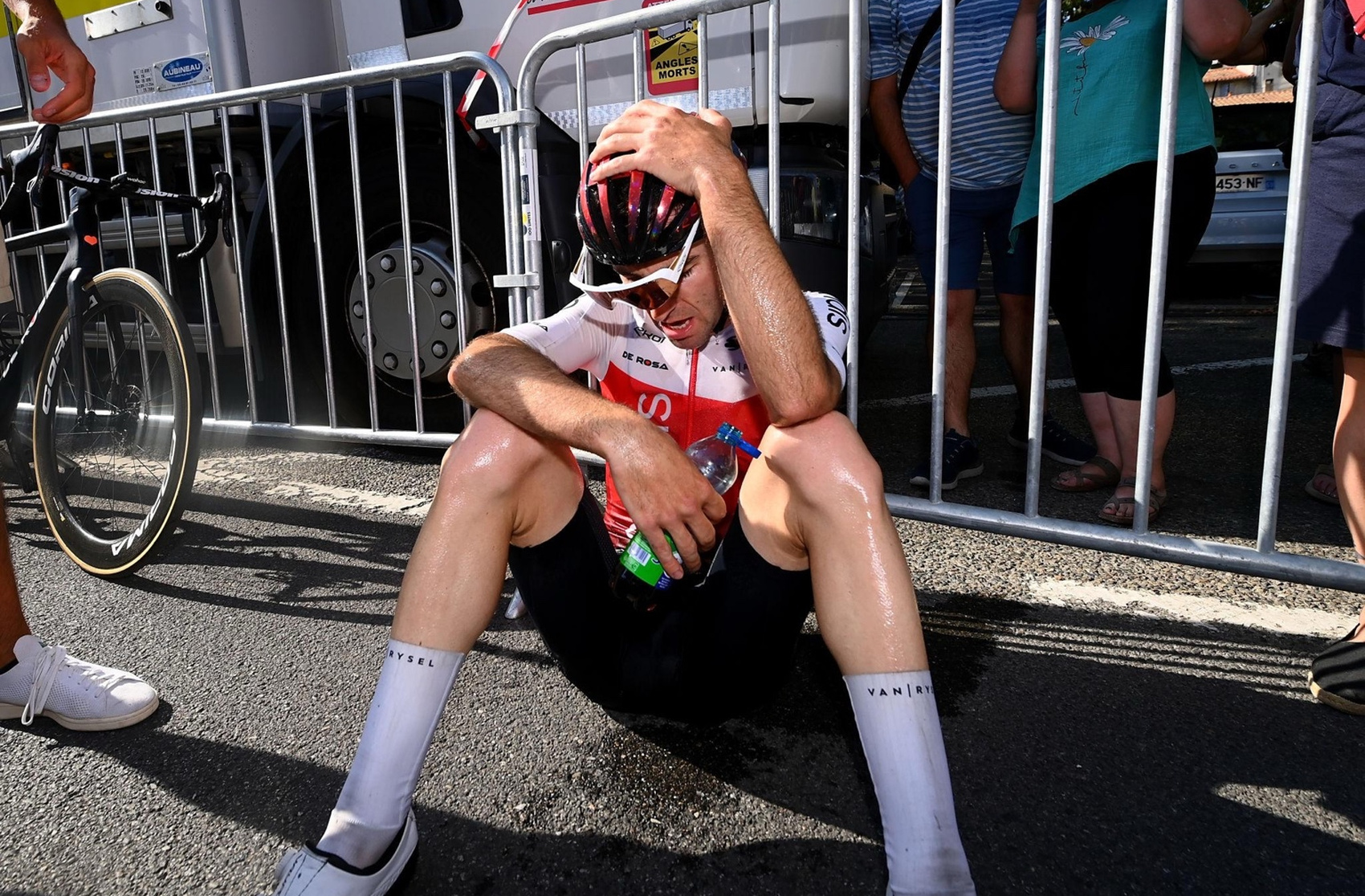

Most endurance athletes look for ways to improve their performance in the wrong places. They train harder, increase their training volume or invest in new running bikes, aero clothing or power meters. Some change their training plan, others optimise their riding position or try to find that decisive edge through ever more detailed performance data.
This easily gives the impression that better performance is primarily a question of training. Yet this is precisely where a widespread misunderstanding lies. Most ambitious athletes do not train too little. Many even train with remarkable consistency. They have high-quality equipment, analyse their performance data and are deeply committed to their sport. Nevertheless, their progress often stagnates for months or even years.
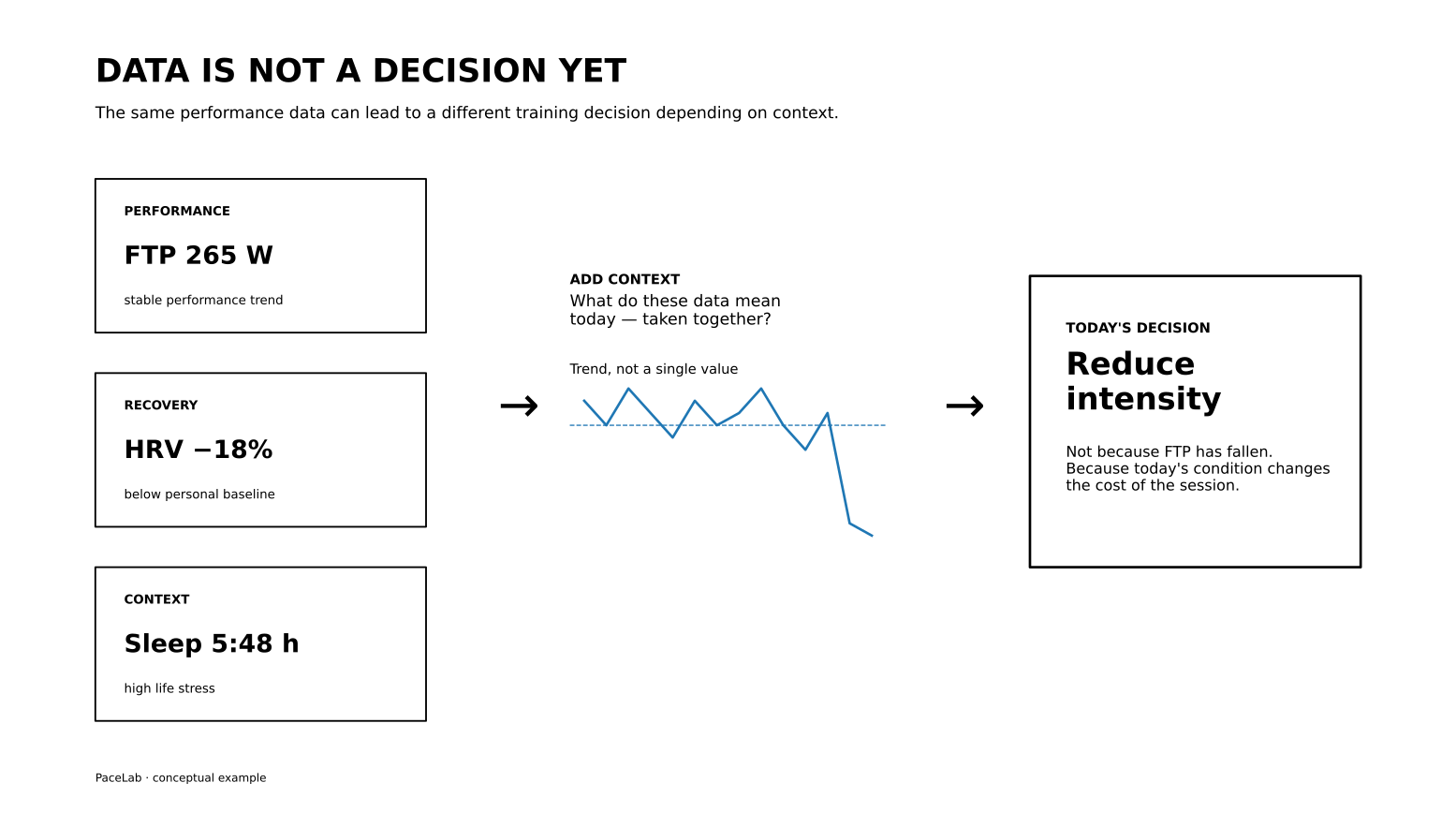
Not because they aren’t working hard enough. But because they make daily decisions that limit their performance. They start intense sessions with insufficiently replenished glycogen stores. They underestimate the impact of sleep and recovery. They carry out training sessions despite increased fatigue, even though an additional recovery session would have been more productive in the long term. They interpret performance data in isolation, without taking the physiological context into account. None of these decisions, taken on its own, has a dramatic effect. Taken together, however, they determine whether an athlete realises their full potential – or remains permanently below it.
This is exactly where PaceLab comes in.
We do not view endurance performance solely as a training issue. We view it as a decision-making issue.
After all, training is just one of many factors that determine performance. Equally important is the ability to make the right decisions every day – before, during and after every training session. Those who make better decisions do not necessarily train more. But they almost always train better.
Why this article is important
An athlete’s fitness is not determined solely by the quality of their training. It is the result of the interplay of countless decisions that often seem insignificant but, over weeks and months, add up to a significant difference.
This article therefore forms the basis for much more content on PaceLab. Because before we can talk about nutrition, fuelling, recovery or training management, we need to answer a fundamental question:
What actually determines whether an athlete reaches their potential?
Training is only part of the equation. Anyone who wants to improve in endurance sports almost inevitably thinks of training first. More kilometres. More intervals. More intensity. A new training plan. Perhaps even a new coach.
This way of thinking is understandable. After all, training is the most visible part of sport. It’s what we upload to Strava, complete on Zwift or analyse on our running watch. But that’s precisely where the problem lies. We tend to equate training with performance development.
Yet training is merely the stimulus. The actual adaptation only occurs afterwards. Our body doesn’t get stronger during an intense interval session. It gets stronger when it is given sufficient energy, time and the right conditions to adapt to that stimulus.
That’s why, after every training session, a crucial question arises:
Can your body actually make the most of the training in the way you hope it will?
This question is asked surprisingly rarely. Instead, many athletes focus almost exclusively on the training plan. Every session is carried out as precisely as possible. The wattage figures are correct, the heart rate is on target and the training load falls within the planned range. Yet the desired progress often fails to materialise.
Not because the training plan is poor. But because performance depends on far more factors than the training load itself.
Sleep influences hormonal recovery. Nutrition determines whether there is sufficient energy available for training and adaptation. Stress – whether work-related or personal – increases the overall strain on the body. Carbohydrate intake determines the quality with which high-intensity sessions can be completed at all. Even fluid and sodium balance can noticeably alter performance on any given day. None of these factors can replace good training. But each one can either enhance or significantly limit its effectiveness.
That is why the classic question asked by many athletes falls short:
How should I train?
The more important question is:
Which decision will bring me closest to my long-term performance development today?
On some days, the answer really is: *a tough interval session. On other days, the best decision might be: more carbohydrates, going to bed an hour earlier, or even an extra rest day. These decisions often feel unspectacular. Their impact, however, is anything but. After all, peak performance rarely results from a single exceptional training session. It arises from hundreds of small decisions that reinforce one another over months and years.
And that is precisely why, at PaceLab, we do not view endurance performance as a training problem. Rather, we see it as a system of daily decisions.
Why small decisions make a big difference to performance
In endurance sports, we often look for the one decisive factor.
The perfect training plan.
The optimal supplement.
The ideal riding position.
Or that one training session that triggers the next leap in performance.
But the reality is far less spectacular. Performance development is rarely the result of a single major decision. Far more often, it arises from the sum of countless small decisions which, taken individually, are hardly significant.
A night with just a little too little sleep.
An intense session with glycogen stores half-empty.
A rest day that, out of a guilty conscience, turns into a light ride after all.
Not drinking enough on a hot training day.
A few days with unnecessarily high levels of everyday stress.
None of these decisions will ruin your season. Nor will a single perfect decision suddenly transform your performance. The difference comes down to repetition. The human body continuously adapts to the conditions to which it is exposed. It doesn’t evaluate individual days, but patterns. Those who regularly provide their bodies with sufficient energy, get high-quality sleep, balance training and recovery sensibly, and manage stress intelligently create better conditions for adaptation. Not because every single decision is extraordinary, but because they reinforce one another.
The opposite is equally true. Anyone who regularly eats too little, treats sleep as negotiable, or ignores the body’s warning signals will often still make progress – at least for a while. But at some point, the gap between the effort invested and the actual performance gain will grow ever wider. Many athletes respond to this with even more training. Yet the real problem often lies not in a lack of training stimulus, but in the conditions under which this stimulus has to be processed. More training rarely solves this problem. In the worst-case scenario, it may even exacerbate it.
That is why, at PaceLab, we do not talk about optimising individual factors. We view the athlete as a holistic system.
Training influences nutrition.
Nutrition influences recovery.
Recovery influences the quality of the next session.
The quality of the next session, in turn, influences training progress.
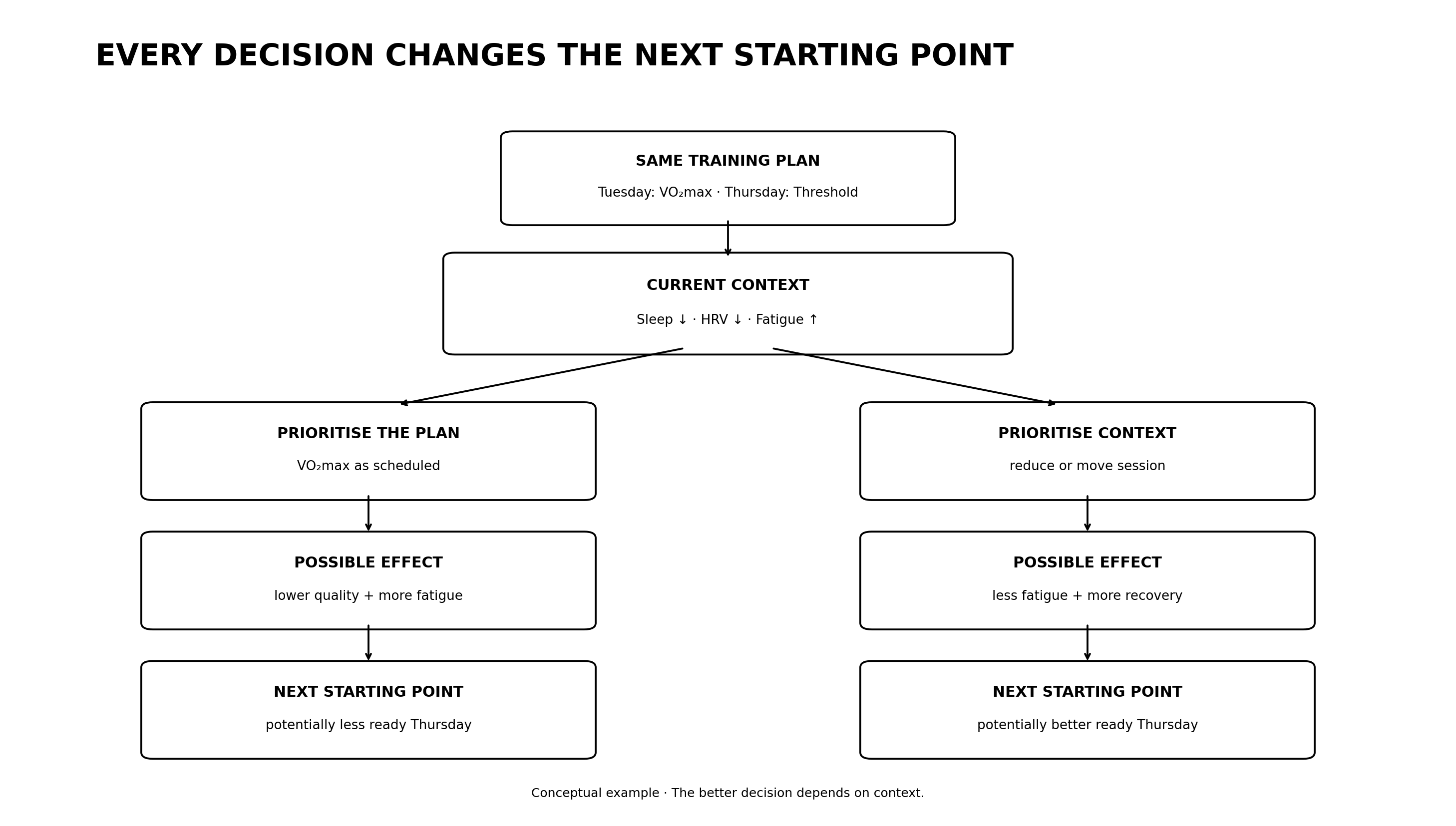
Every decision changes the starting point for the next one. This is precisely why endurance performance is not a jigsaw puzzle made up of independent pieces. It is a dynamic system. And this is precisely why it is not enough to optimise individual metrics. The crucial skill lies in making the right decision at the right moment.
Not just once.
But time and time again.
Over weeks.
Over months.
Over years.
Knowledge alone does not lead to better decisions
Anyone involved in endurance sport today has never had access to as much information as they do now. Training plans are just a few clicks away. Scientific studies are summarised on YouTube. Podcasts discuss the latest findings in training science. Apps provide data on performance, heart rate, sleep, recovery and exertion every second. Information is no longer a scarce commodity.
On the contrary.
The real challenge today is to draw the right conclusions from the flood of information. Because knowledge and decision-making are not the same thing.
An athlete may know full well that carbohydrates are beneficial before intense exercise – and yet still eat too few. They may know that sleep improves recovery – and yet still work until midnight or scroll through social media. They may realise that their fatigue levels are unusually high – and yet still train because the training plan says so. This is not because these athletes lack discipline. It is because decisions are always made within a specific context.
Our body has no concept of a training plan. It is only aware of its current state. It knows how well we slept last night. The stress of the past working week. The energy at its disposal. The strain from previous training sessions. The ambient temperature. Our fluid balance. The immune system. And many other factors that influence one another.
That is precisely why there are rarely simple answers in endurance sport.
A tough interval session may be the best decision on one particular day. Under almost identical conditions, the same session a few days later may be exactly the wrong decision. Not because the training plan has changed. But because the athlete has changed. Performance therefore does not result from rigidly following plans. It arises from the ability to correctly assess one’s own condition and respond appropriately. For this, we need data. But data alone is not enough.
A heart rate of 145 beats per minute does not, at first glance, tell us whether it is appropriate or unusually high today. An HRV of 48 milliseconds is neither good nor bad unless we know its context. Even an FTP is, ultimately, just a number. It is only when data is placed in the right context that it becomes information. And it is only when information leads to better decisions that real added value is created.
This is precisely where Decision Intelligence begins. Not with more data. But with better decisions based on the right data.
Decision Intelligence begins where standard recommendations end
Many recommendations in endurance sport are fundamentally correct. Train regularly. Get enough sleep. Make sure you’re fuelled with carbohydrates. Schedule rest days. Drink enough.
The problem isn’t that these recommendations are wrong. The problem is that, on their own, they do little to help you make the right decision at the right moment. After all, sport doesn’t take place under laboratory conditions.
Perhaps you’ve slept poorly. Perhaps the working week has been exceptionally stressful. Perhaps you’re out training in 30-degree heat. Perhaps your immune system is currently channelling more energy into fighting off an emerging infection than you even realise. Perhaps you trained harder than planned yesterday.
In all these situations, the same advice can lead to different decisions. That’s precisely why we don’t believe in rigid rules. We believe in better decisions.
For us, Decision Intelligence describes the ability to put as much relevant information as possible into a meaningful context – and to derive from this a decision that suits the athlete’s current situation. This is explicitly not about analysing every little detail or perfecting every decision. Nobody makes only optimal decisions every single day. That is neither realistic nor necessary. What matters is something else: increasing the likelihood of making a better decision today than yesterday.
Sometimes this means seeing an intense session through to the end. Sometimes it means deliberately reducing the intensity. Sometimes it even means leaving the bike at home. Not out of laziness. But because it is precisely this decision that lays the foundation for performance development in the days to come. Endurance performance is not built in a single training session. It arises as a result of many decisions that build on one another.
Every decision changes the starting point for the next one.
That is precisely why we do not view training, nutrition, recovery and workload management as separate issues. They are components of the same system. Those who optimise only one of these areas often squander their potential. Those who, on the other hand, understand how they interact make better decisions – often without having to train any more. And this is precisely where we see the real opportunity in modern training management.
Not in collecting ever more data. But in using the information available to make better decisions.
For us, that is Decision Intelligence.
Not just a buzzword. But a way of thinking.
A real-life example
Let’s imagine two ambitious cyclists. Both train four times a week. Both have a comparable FTP. Both follow the same training plan.
At first glance, their progress should be almost identical. Yet after a few months, a different picture emerges.
The first athlete’s performance improves steadily. Intense sessions feel manageable. He recovers reliably, remains largely healthy and regularly achieves new personal bests.
The second athlete invests at least as much time and motivation. Nevertheless, their performance stagnates. They often feel tired, postpone training sessions due to a lack of energy or repeatedly struggle with minor infections. Intense intervals are rarely completed to the planned standard.
What has happened?
The answer is often not: a poor training plan. The differences usually lie elsewhere.
The first athlete begins intensive sessions with sufficiently full glycogen stores. He pays attention to his carbohydrate intake during prolonged exertion. After hard training sessions, he prioritises recovery and sleep. He recognises phases of increased fatigue early on and adjusts his workload before they become a problem.
The second athlete also makes many of these decisions – though not consistently. He occasionally trains on an empty stomach, even though an intense session is planned. After training, he postpones his meal because everyday commitments get in the way. During the week, he regularly sleeps an hour too little and yet sticks to his training plan.
None of these decisions seems particularly significant on its own. Yet, over weeks and months, they result in two completely different starting points.
The first athlete is consistently able to convert the training stimuli into physiological adaptations. The second athlete, whilst putting in a similar amount of effort, creates significantly poorer conditions for his body to respond to that effort. From the outside, both athletes appear equally hard-working. On the inside, however, their bodies are operating under completely different conditions.
This is precisely why performance cannot be explained solely by training hours, wattage figures or FTP. Only when we understand the conditions under which this performance was achieved can we assess why one athlete progresses – whilst another stagnates despite a comparable training load.
In this example, the training plan was never the actual problem. It was the day-to-day decisions.
What does this mean for your training?
If endurance performance is the result of countless decisions, the question inevitably arises:
Which decisions have the greatest influence?
There is no one-size-fits-all answer. Every athlete has different circumstances, goals and conditions. Nevertheless, there are some principles that apply almost regardless of performance level or training volume.
1. Never view your training in isolation.
A training session doesn’t begin with the first pedal stroke. It begins with the decisions you made hours or even days beforehand.
How did you sleep? How high was your stress level? Did you eat enough? How well have you recovered from previous exertions?
Anyone who views training in isolation from these factors often assesses only the symptoms – not the causes.
2. Prioritise the quality of your sessions.
More training does not automatically mean better training. A high-quality interval session, which is well prepared and completed in full, is often more valuable in the long term than two half-hearted sessions undertaken whilst fatigued. Quality does not happen by chance. It is the result of good preparation.
3. Stop viewing recovery as lost training time.
Many ambitious athletes feel guilty when they take an extra rest day. Yet adaptation doesn’t happen during exercise. It happens during recovery. A rest day is therefore not a sign of a lack of discipline. It is often an indication of good training management.
4. Use data to understand relationships – not just to collect figures.
Modern sports watches and platforms now provide an enormous amount of information. But data is not an end in itself. The crucial question is not:
How many metrics can I measure?
But rather:
What decision can I make better today based on this information?
If a metric doesn’t change your behaviour, it often has less practical value than it initially appears to have.
5. Think long-term.
Performance development isn’t a project for the next two weeks. It develops over months and years. That’s why it’s worth not attaching too much importance to every single training session. What matters isn’t whether everything goes perfectly today. What matters is whether, over the long term, your decisions are more often right than wrong. That is precisely where sustainable progress lies.
Not in perfection. But in consistency.
Perhaps that is precisely the most important insight from this article. Most athletes don’t need a completely new training plan. They need to make better decisions within their existing system. And that is often where the greatest untapped potential for performance lies.
Conclusion
Endurance sport is often seen as a question of training. How many kilometres? How many intervals? How many watts?
These questions are important. But they don’t tell the whole story. Because training is merely the trigger. Whether this actually leads to improved performance is determined by many other factors. Before the session. During the session. After the session. And often even far away from the bike.
Performance is built where good decisions build on one another. Those who get enough sleep regularly, prepare their training sensibly, manage their workload intelligently and provide their bodies with the necessary energy create the conditions for training to have its full effect in the first place. That sounds unspectacular. That is precisely why it is so often underestimated.
We don’t believe that successful athletes simply train harder. We believe they make the right decisions more often. Not perfectly. But consistently. And that is precisely where we see the difference between short-term successes and sustainable performance development. That is why we don’t view endurance performance as a training problem. But as a decision-making problem.
Not every decision will make a difference. But every decision changes the starting point for the next one. And it is precisely this chain of decisions that ultimately determines the potential an athlete can realise in the long term.
Perhaps that is why the greatest progress does not lie in training even harder. But rather in making the next decision just a little bit better than the last.
Key insights
- Training is just one of many factors that determine performance development.
- Small decisions have an impact through consistent repetition.
- Data only becomes valuable when it leads to better decisions.
- Recovery, nutrition, sleep and load management are not side issues, but integral parts of the same system.
- Long-term performance development does not come from perfection, but from a large number of good decisions.