You’ve been training consistently for weeks.
Your intervals are spot on. Your training plan is well structured. Yet your performance figures have plateaued and those extra ten watts of FTP you were hoping for just won’t materialise. So you’re looking for the next training stimulus. Perhaps you need more VO₂max intervals. More ‘sweet spot’ training. More volume. Or simply a bit more intensity.
But perhaps the problem lies elsewhere entirely.
You may well have enough power. You’re simply not providing your body with enough energy to tap into it reliably.
This is exactly where fuelling comes in.
In endurance sport, carbohydrates are far more than just extra calories during a long ride. At higher intensities, they are a key energy source. How much of this is available therefore affects not only how long you can ride, but also the quality with which you can complete and repeat intense efforts. That changes the perspective.
We devote an enormous amount of attention to our FTP. We analyse wattage figures, plan training blocks and look for ways to boost our physiological performance by a few per cent. At the same time, many athletes still treat their energy supply as a mere detail. That’s a mistake.
After all, what good is a higher FTP if you can’t deliver the necessary power at the crucial moment? Or to put it another way:
Before you try to make your engine bigger, you should ensure there’s enough fuel in the tank.
Fuel management is no substitute for good training. Carbohydrates won’t turn an untrained athlete into a fast one. Nor will even the perfect nutrition strategy make up for a lack of fitness. But poor fuel management can prevent you from making the most of the fitness you already possess. And that’s precisely why the next big performance reserve may not always lie in your training plan, but rather in the bottle on your bike.
What does fuelling mean in endurance sport?
Fuelling refers to the targeted supply of energy to the body before, during and after exercise. In endurance sport, the focus is primarily on carbohydrates, as they are a crucial source of energy for working muscles as intensity increases. Fuelling is therefore about more than just which gel you take with you on a long ride. It starts even before training.
How full are your glycogen stores? When did you last eat? What kind of exercise are you about to do? How long will you be out and about? And how quickly do you need to recover afterwards for your next session?
All of this forms part of a sensible fuelling strategy. Our bodies essentially have various ways of providing energy for physical exertion. Fats and carbohydrates are particularly relevant. Even in very lean athletes, our fat reserves are enormous. In purely energetic terms, they could sustain us over very long periods. The situation is different with carbohydrates.
Among other things, they are stored as glycogen in the muscles and liver. These stores are limited. At the same time, as exercise intensity increases, the importance of carbohydrates for energy supply grows. This is crucial for ambitious endurance athletes. After all, a relaxed base ride places different demands on energy supply than a threshold interval, a long climb or a Zwift race with repeated attacks well above FTP.
The higher the intensity, the more important the rapid provision of energy becomes. And this is precisely where carbohydrates have a decisive advantage. They can provide energy more quickly than fats, thereby enabling high levels of performance that could not be sustained by fat metabolism alone.
That is why the crucial question when it comes to fuelling is not simply:
‘How many calories am I burning?’
But rather:
‘How much energy does my body need for the exact level of performance I’m demanding of it?’
That’s a crucial difference. An athlete may have sufficient energy reserves and yet still be energy-limited during intense exercise. This is because stored body fat and energy immediately available for high performance are not the same thing. That is precisely why fuelling is not purely a nutritional issue.
Fuel management is part of performance management.
It’s about providing the body with the energy source it needs for the planned exertion at exactly the right time. Not as much as possible. Not as little as possible. But just the right amount for the task at hand.
Why do endurance athletes need carbohydrates?
Carbohydrates are a key energy source in endurance sport, particularly at moderate and high exercise intensities. Their importance increases as intensity rises, because energy from carbohydrates can be made available for muscle work more quickly than energy from fat.
To understand why this is so important, we need to take a brief look at energy supply. Our muscles require ATP – adenosine triphosphate – for every contraction. However, the immediately available ATP stores in the muscles are very small. The body must therefore continuously produce new ATP during exercise. It can use various energy sources for this.
During prolonged endurance exercise, fats and carbohydrates play a particularly important role. Fat has one key advantage: we have a great deal of it stored. Carbohydrates have another: speed.
They can contribute to ATP production both aerobically and – at very high intensities – via rapid glycolytic processes. This means that carbohydrates can support high energy turnover rates, particularly when performance demands increase. For a cyclist, this becomes relevant at the latest when a leisurely ride turns into serious work.
A long climb. A threshold interval. A sprint. Several hard VO₂max intervals. Or a Zwift race in which the rider repeatedly switches between moderate effort and very high output within a matter of minutes.
In such situations, carbohydrate utilisation increases significantly. The body draws on muscle glycogen, amongst other sources. At the same time, the glycogen stored in the liver helps to maintain blood sugar levels. During prolonged exercise, additional carbohydrates consumed can provide a further source of energy.
The problem: our carbohydrate stores are limited.
How much glycogen an athlete can store depends, amongst other things, on muscle mass, diet and fitness level. Unlike with body fat, therefore, there is no practically unlimited reserve available. When available carbohydrates run low, performance is affected. The classic example is the notorious ‘hitting the wall’ or ‘man with the hammer’.
However, the problem should not be reduced to this alone.
You don’t need to have completely depleted glycogen stores and feel utterly drained for a decline in carbohydrate availability to become an issue. Even before that happens, it can become more difficult to maintain high intensities or to sustain them repeatedly.
And this is precisely where fuelling becomes important for ambitious athletes. The aim is not just to prevent a dramatic drop in performance after three hours. It’s about maintaining the desired level of performance for as long as possible.
This applies in competition. But it applies just as much in training. Because if the final intervals of a session regularly fail not due to a lack of fitness but due to a lack of energy availability, you aren’t automatically training harder. You may simply be training less effectively. And if this pattern repeats itself week after week, a fuelling problem will eventually turn into a training problem.
Why many endurance athletes still don’t fuel enough
Many ambitious endurance athletes consume fewer carbohydrates during intense or prolonged exercise than would be advisable for optimal performance. This is often driven by outdated nutritional myths, a desire to lose weight, or simply the habit of only taking fuelling seriously once hunger sets in or there is a significant drop in performance.
For decades, it was part of the culture of endurance sport to be as independent as possible from external energy intake. Anyone who could ride for long periods without eating was considered well-trained. Training sessions on an empty stomach were associated with particularly effective fat metabolism. At times, carbohydrates were even viewed with suspicion: too much sugar, too many calories, bad for body composition.
Some of these ideas do have a physiological basis.
Training with low carbohydrate availability can influence certain signalling pathways associated with adaptations in oxidative metabolism. However, this does not automatically mean that minimising carbohydrate intake leads to better training results. After all, every training method comes at a cost.
Those who train with low carbohydrate availability do not merely alter the metabolic stimulus. Depending on the intensity and duration, the ability to achieve the desired training performance may also decline. This is precisely where a common misconception often arises.
Maximum metabolic load is not the same as maximally productive training.
If the aim of a session is to produce repeated high-intensity efforts, to complete high-quality VO₂max intervals or to work at the threshold for a prolonged period, the body must also be able to provide the energy required to sustain this performance. An empty tank does not automatically make the session better. Initially, it simply makes it harder. And harder is not always more productive.
There is also a second problem: many athletes base their energy intake on hunger and thirst. Both are of limited use when it comes to managing fueling. During intense exercise, the sensation of hunger can be dulled. At the same time, an energy deficit does not only arise at the very moment the body clearly demands something to eat. Anyone who waits until their performance noticeably drops is therefore often reacting too late.
Fuel intake should not be a remedy for a problem that has already arisen. It should prevent that problem from arising in the first place.
However, this does not mean consuming several energy gels during every easy 45-minute session. That, too, would be an unnecessary oversimplification. Carbohydrate intake should be tailored to the intensity of the session. A short recovery session places different demands on the body than two hours of threshold intervals. An easy base ride is, in terms of energy requirements, quite different from a race with repeated anaerobic peaks.
Not every training session requires maximum carbohydrate intake. But every training session deserves a conscious decision about how much energy it requires.
That is the difference between eating whilst exercising and a genuine fuelling strategy.
Fuelling affects more than just your performance in competition
A good fuelling strategy can do more than just support acute performance during a single session. Adequate carbohydrate availability can also help maintain the quality of intense training sessions and support the replenishment of glycogen stores between sessions. It is precisely this point that is often underestimated.
Fuelling is often viewed as a competition strategy.
On race day, gels are counted, bottles are prepared and carbohydrate intake is planned. In normal training, however, nutrition is handled much more casually. Yet the majority of your performance development does not take place during the competition itself, but in the weeks and months leading up to it.
Training quality
Imagine a session with five tough intervals.
You complete the first two exactly within the intended intensity zone. The third one gets tough. In the fourth, your performance drops. You cut the fifth short. The obvious interpretation is:
The session was too hard.
Perhaps that’s true. But perhaps it wasn’t your cardiovascular or muscular capacity that was the limiting factor, but rather the availability of energy. That’s a crucial difference.
After all, the training stimulus from a high-intensity session doesn’t come from it feeling as brutal as possible. It comes from your ability to maintain the load relevant to your training goal with sufficient quality and duration. If good fuelling helps turn three high-quality intervals into five, it indirectly alters the training stimulus as well. Fuelling then does more than just support your performance.
It supports the quality of your training.
Recovery
Once the exertion is over, the next part of the process begins. Depleted muscle glycogen must be replenished. Carbohydrates play a central role in this. How urgently this needs to happen depends on the context.
Someone who doesn’t train again until two days later is in a different situation to an athlete who wants to complete another demanding session the very next morning. The shorter the time between two training sessions, the more important it is to specifically replenish your carbohydrate stores.
Here, too, it becomes clear:
The optimal decision does not depend on a single metric. It depends on what comes next.
Readiness for the next session
This brings us full circle to our fundamental idea behind PaceLab:
Every decision changes the starting point for the next one.
If you complete a tough session with sufficient energy reserves, you may be able to perform more high-quality work. If you then replenish your energy stores appropriately, you improve the conditions for the next session. If, in turn, you start that next session with sufficient energy, the likelihood increases that the planned training quality will be achieved there too.
A single fuelling decision thus gives rise to a chain of events.
And that is precisely why we do not view fuelling as an isolated nutritional issue. It is an integral part of training management. Of course, this does not mean that more carbohydrates automatically lead to greater training progress. Training must still be sensibly paced. Recovery remains essential. Sleep cannot be replaced by an energy gel. And if you consistently consume more energy than you need, this won’t solve any performance issues either.
The crucial question is therefore not:
“How can I get as many carbohydrates into my body as possible?”
But rather:
‘How much carbohydrate availability do I need to optimally support the goal of this session?’
It is precisely this distinction that makes fuelling a strategy.
How many carbohydrates per hour are appropriate for endurance sports?
The amount of carbohydrates you need during training or competition depends primarily on the duration, intensity and objective of the session.
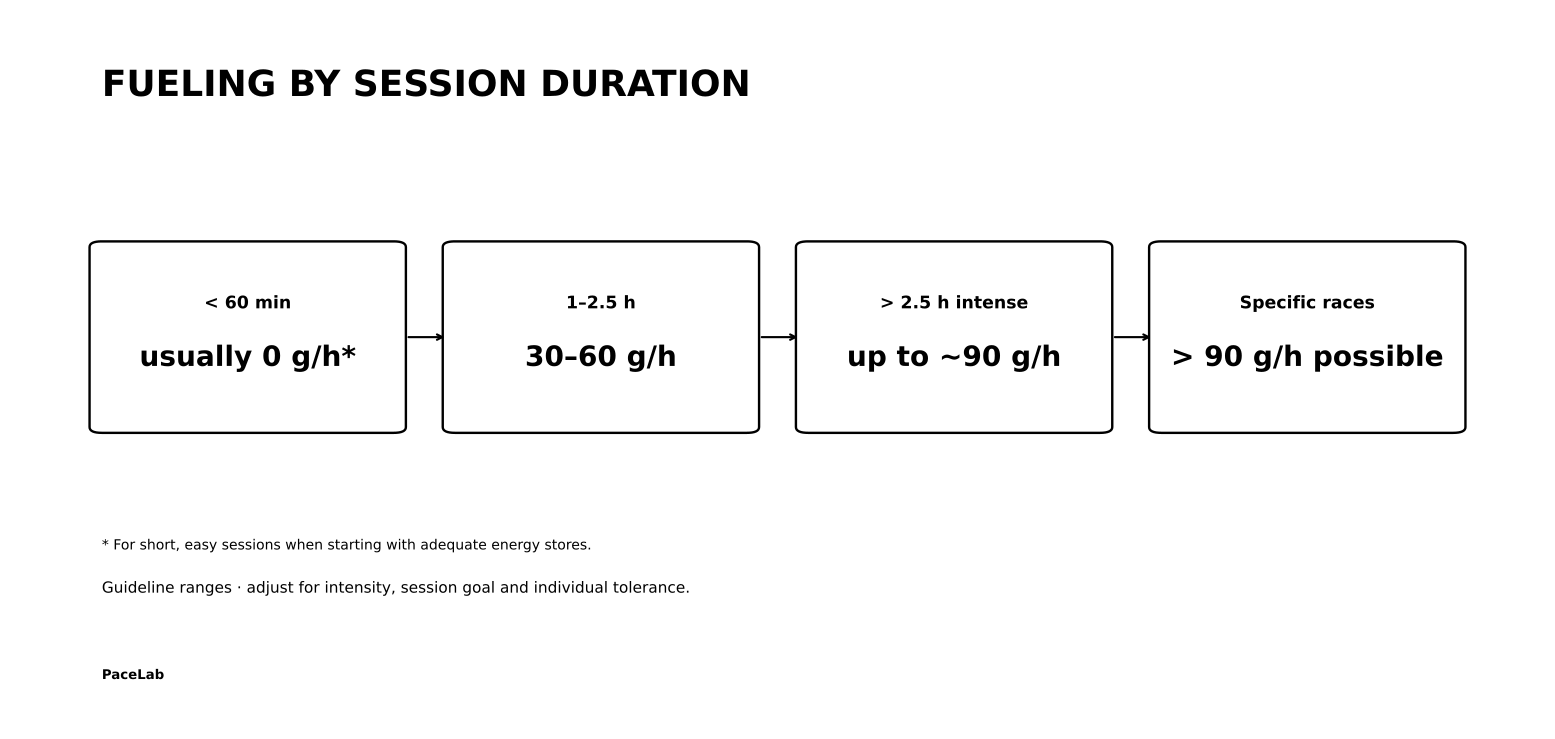
As a rough guide, recommendations range from no essential carbohydrate intake for short, easy sessions to around 90 g of carbohydrates per hour for long and intense endurance sessions. In certain competitive situations, well-trained athletes may also utilise higher amounts.
The key message is therefore:
There is no single optimal amount of carbohydrates for every training session.
Fuel intake should be tailored to the activity.
Under 60 minutes
For short, low-intensity sessions, carbohydrate intake during training is generally not necessary, provided you start with adequately replenished energy stores. However, this does not mean that carbohydrates are fundamentally useless.
For short but very intense sessions, the availability of carbohydrates before training can already be a factor. Anyone wishing to complete a high-intensity Zwift session, for example, should therefore not focus solely on the duration.
60 minutes of easy riding and 60 minutes of racing are, metabolically speaking, two completely different tasks.
Approximately 1 to 2.5 hours
As duration and intensity increase, carbohydrate intake during exercise becomes more important. For many endurance sessions in this range, approximately 30 to 60 g of carbohydrates per hour is a sensible guideline.
The more intense the session and the greater the importance of training quality, the more likely it is that your requirements will be towards the upper end of this range. A relaxed two-hour base ride therefore does not need to be fuelled in quite the same way as two hours of long threshold intervals.
Long and intense sessions
For sessions lasting more than around 2.5 hours, up to approximately 90 g of carbohydrates per hour may be advisable, particularly if the aim is to maintain a high level of performance for as long as possible. It is at this level, at the very latest, that the composition of the carbohydrates consumed also becomes relevant.
The gut can only absorb glucose, or carbohydrates derived from it, at a limited rate. By combining different sources of carbohydrates – particularly glucose and fructose – different intestinal transport pathways can be utilised. This allows greater quantities of carbohydrates to be absorbed and oxidised than would be possible with a single source of carbohydrates. This is precisely why many modern sports drinks and gels are based on so-called multiple-transportable-carbohydrate mixtures.
Is consuming more than 90 g of carbohydrates per hour advisable?
This is where it gets interesting. In recent years, carbohydrate intakes of over 90 g per hour have also been studied and are increasingly being used, particularly in professional cycling and during very long endurance competitions. However, this does not mean that 100, 120 or even more grams per hour are automatically better.
The higher the carbohydrate intake, the more important individual tolerance, duration of exertion, intensity and a suitably trained gastrointestinal tract become. More is therefore not automatically better. The optimal amount is that which meets the energy requirements of the exertion whilst also being reliably tolerated.
The gut can be trained
Fuel management itself requires training. Anyone who normally consumes 30 g of carbohydrates per hour and suddenly tries to consume 90 g or more on competition day risks gastrointestinal discomfort. Higher amounts of carbohydrates should therefore be tested gradually during training. In doing so, the athlete is not only training their legs, heart and lungs; they are also training their ability to absorb and process energy during high-intensity exercise.
This leads to an important principle:
Train your fuelling strategy just as you train your performance.
After all, the best theoretical carbohydrate strategy is worthless if your body cannot tolerate it under competition conditions.
What does this mean in practical terms for your training?
A good fuelling strategy doesn’t have to be complicated. You don’t need to plan every training session down to the last gram, nor do you need to constantly consume carbohydrates during every ride. The key is that your energy intake matches the aim of the session.
A few simple principles can help with this.
1. Fuel the work you want to do
The longer and more intense a session is, the more important carbohydrate availability becomes. For recovery sessions or short, easy sessions, additional carbohydrate intake during exercise may not be necessary. However, if threshold intervals, VO₂max training, a race or a long ride are on the agenda, the situation changes. If high-quality training is your goal, you should also provide your body with the energy it needs to achieve this.
2. Don’t wait until your performance drops to start eating
Fuel management works best as a preventative measure. If you’re already feeling noticeably hungry during a long or intense session, or if your performance drops due to a lack of energy, your strategy may be too late. Therefore, plan your carbohydrate intake in advance – not as a reaction to the problem, but to avoid it where possible.
3. View fuelling before, during and after your session as a whole
The carbohydrates in your water bottle are only part of the strategy. Your nutritional status at the start of a session and how you refuel afterwards are also crucial. Preparation, fuelling during exercise and recovery all go hand in hand.
4. Train your gut
If you want to use large amounts of carbohydrates during long or intense sessions, you shouldn’t try them out for the first time on race day. Increase your intake gradually and observe which quantities and products you can reliably tolerate even under high exertion. Your fuelling strategy should be tested in training just as much as your race tactics.
5. Don’t just copy a number – understand the task
90 grams of carbohydrates per hour is no badge of honour. And 30 grams is no sign of poor fuelling.
Both can be right.
Or wrong.
The decisive factors are duration, intensity, training goal, starting point and individual tolerance. That is precisely why we don’t think much of blanket fuelling rules.
The better question isn’t:
“How many carbohydrates should an endurance athlete generally consume?”
But rather:
“What energy intake supports the performance I want to achieve today?”
Anyone who can answer this question will no longer view fuelling as merely a nutritional detail, but as part of their performance strategy.
Conclusion: Before you increase your FTP, make the most of the performance you already have
FTP remains a key metric in cycling. Higher aerobic capacity makes you faster. No gel or sports drink can replace good training. But that was never the real question.
The crucial question is:
Can you reliably tap into the performance capacity you’ve built up in training?
This is precisely where fuelling comes into its own. Carbohydrates are a key energy source, particularly at higher intensities. If they aren’t sufficiently available, your ability to maintain high performance levels and repeat them may decline.
This doesn’t just apply to competition. It also affects the quality of your training. Anyone who regularly completes intense sessions with insufficient energy reserves may be making their training harder – but not necessarily better. That’s why it’s worth treating fuelling for what it actually is:
part of your performance strategy.
Not every session requires 90 grams of carbohydrates per hour. Not every ride needs a gel. And more carbohydrates aren’t automatically better.
The key is to tailor your energy intake to the task at hand. Perhaps you do actually need a higher FTP for your next leap in performance. But perhaps what you need first is the ability to make better use of the FTP you already have.
So, before you set your sights on the next ten watts, it’s worth asking yourself another question:
Are you actually giving your body enough energy for the performance you expect from it?
Key takeaways
- Fuel management is performance management. Your energy supply influences the level of performance you can achieve and sustain during exercise.
- The higher the intensity, the more important carbohydrates become. Their importance increases particularly during threshold training, VO₂max intervals, races and long, intense sessions.
- More isn’t automatically better. The optimal carbohydrate intake depends on duration, intensity, training goal and individual tolerance.
- 30 to 60 g of carbohydrates per hour can be a sensible range for many longer sessions; for long and intense sessions, around 90 g/h may be appropriate. Higher amounts are possible, but not a universal target.
- Fuel management doesn’t start with the first gel. Pre-exercise nutrition, carbohydrate intake during exercise and the replenishment of glycogen stores afterwards form an integrated system.
- Train your gut. High carbohydrate intakes should be tested gradually under realistic training conditions.
- Good fuelling is no substitute for good training. However, it does help you get more out of good training.
Scientific Basis & Sources
The recommendations and physiological principles outlined in this article are based on the current sports science literature on carbohydrate availability and carbohydrate intake in endurance sports.
Further Reading
Burke LM, Hawley JA, Wong SHS, Jeukendrup AE. (2011).
Carbohydrates for training and competition.
Journal of Sports Sciences, 29(S1), S17–S27.
DOI: 10.1080/02640414.2011.585473
A seminal study on periodised carbohydrate availability and on adapting carbohydrate intake to training and competition requirements.
Jeukendrup AE. (2014).
A step towards personalised sports nutrition: carbohydrate intake during exercise.
Sports Medicine, 44(Suppl 1), pp. 25–33.
DOI: 10.1007/s40279-014-0148-z
A review of individual carbohydrate intake during exercise and the basis for recommendations differentiated by exercise duration.
Thomas DT, Erdman KA, Burke LM. (2016).
Nutrition and Athletic Performance.
Medicine & Science in Sports & Exercise, 48(3), 543–568.
DOI: 10.1249/MSS.0000000000000852
Joint position paper by the Academy of Nutrition and Dietetics, Dietitians of Canada and the American College of Sports Medicine on nutrition, performance and recovery in sport.
Jeukendrup AE. (2017).
Training the Gut for Athletes.
Sports Medicine, 47(Suppl 1), 101–110.
DOI: 10.1007/s40279-017-0690-6
A review of the adaptability of the gastrointestinal tract and the targeted improvement of carbohydrate tolerance and absorption during prolonged exercise.
Podlogar T, Wallis GA. (2022).
New Horizons in Carbohydrate Research and Application for Endurance Athletes.Sports Medicine, 52(Suppl 1), 5–23.
DOI: 10.1007/s40279-022-01757-1
A more recent review of carbohydrate metabolism, glucose-fructose combinations, exogenous carbohydrate oxidation and modern fuelling strategies in endurance sport.